Why the Best Talent Might Be Only 10 Kilometers Away
Reimagining the Local Workforce
We have been told for a decade that the world is flat and talent is global, but for the most resilient industrial hubs, the world is actually a 10-kilometer circle. In an era of escalating labor market friction and the logistical complexities of massive relocation, the "perfect" candidate is often sought across
oceans. Yet, this obsession with globalized recruitment frequently overlooks a more sustainable, high-density reality. By shifting the lens from a global map to a modest 10-kilometer radius, organizations can optimize human capital and solve the retention woes that plague modern industry.
Eliminating the Friction of Migration
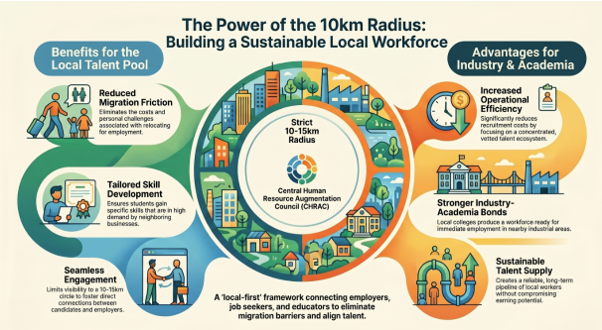
The Central Human Resource Augmentation Council (CHRAC) has pioneered a strategy that limits job and candidate visibility to a strict 10–15 km circle. While this may seem counter-intuitive in a hyper-connected economy, it fosters what strategists call "seamless engagement." By prioritizing proximity, the model removes the physical and psychological barriers that typically degrade the employee experience during the onboarding phase.
"Crucially, this localized focus reduces the fuss of migration for employment and eliminates the various problems associated with relocating for a job."
This localized focus does more than just fill seats; it preserves the social fabric of the community. When we eliminate mobility-related attrition, we see a marked increase in institutional knowledge retention and a reduction in burnout. Residents can scale their career trajectories without uprooting their families, creating a workforce that is not only more stable but more deeply invested in the long-term success of the local Industrial Area.
The "Triple Win" Synergy
Operating within a hyper-local geographic radius creates a symbiotic ecosystem where colleges, training institutions, and companies grow in lockstep. This proximity ensures "just-in-time" skill development, where the curriculum is not merely theoretical but is pressure-tested by the industrial needs existing just down the street.
The "Triple Win" benefits three core stakeholders:
Students: They acquire relevant, hyper-specific skills tailored to the precise requirements of nearby employers, ensuring a frictionless transition into the workforce.
Institutions: They achieve academic-market fit through the constant validation of their curricula by the immediate needs of the local industrial market.
Businesses: They secure a sustainable, consistent pipeline of vetted talent from their own neighborhood, significantly reducing the risks associated with outside hires.
By keeping talent within this local ecosystem, a region ensures that its investment in education creates a circular economy, where local talent stays to fuel local industrial output.
Strengthening the Industry-Academia Bridge
The "local first" approach facilitates direct, high-touch relationships between local industry leaders and academic administrators. This proximity allows for a level of strategic collaboration—such as site visits, guest lecturing, and immediate feedback loops—that is impossible to maintain across long distances.
Furthermore, this model effectively increases the "real" earning potential of the candidate. While a global role might offer a higher gross salary, the hidden costs of long-distance commuting, fuel, transit time, and relocation expenses often erode net take-home pay. By securing immediate employment within a 10km radius, candidates maximize their net earnings and quality of life. This creates a far more sustainable professional lifecycle than the traditional "job-hopping" or long-distance commuting models, which are increasingly seen as liabilities in a modern ESG (Environmental, Social, and Governance) framework.
The Paradox of Efficiency Through Proximity
While many organizations exhaust their budgets on broad, national recruitment campaigns, the hyper-local model demonstrates that shrinking the geographic search area actually drives operational efficiency. By concentrating talent density, the framework provides a strategic financial advantage that ripples through the local tax base and regional economy.
This efficiency is realized through two primary channels:
Reduced Costs: A dramatic reduction in recruitment spend, onboarding timelines, and relocation packages.
Targeted Hiring: High-precision matching between local candidate competencies and the specific technical requirements of the Industrial Area.
This is not merely a social initiative; it is a calculated economic optimization. Keeping the hiring ecosystem compact ensures that recruitment capital stays within the regional economy, strengthening the infrastructure and resilience of the industrial hub.
Conclusion: The Future is Hyper-Local
The 10km radius strategy creates a virtuous cycle that powers regional economic growth. By focusing on what is immediate, businesses and academic institutions can build a workforce that is targeted, cost-effective, and exceptionally resilient.
As we navigate the future of work, we must ask: Would your organization’s bottom line be more robust if you decided to "shrink the map" to grow your impact? In an increasingly digital world, geographic proximity has become a definitive competitive advantage. The most valuable talent in the world isn't a flight away—they are likely already standing right next to you.

Comments